


What Information Do I Need to Provide to Get a Quote From a Custom Coil Manufacturer?
A commercial or industrial coil replacement starts with the details a mechanical contractor or facility manager provides before ever contacting a custom coil manufacturer. Missing a nameplate photo, model number, or material spec turns one submission into several rounds of follow-up questions.
Gathering the right information ahead of time lets Coil Replacement Company (CRC) engineers match the exact OEM replacement HVAC coil to your existing system, with no wasted communication along the way.
What to Bring When Requesting a Quote for a Custom or OEM Replacement Coil
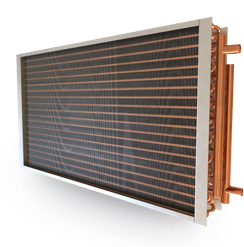
Every quote request for custom replacement coils relies on a handful of core details about your existing system. Checking CRC's full range of coil types ahead of time makes it easier to identify exactly what you're replacing.
Here's what else to have ready before you submit your request.
Your Company Contact Info
CRC needs your name, company name, phone number, and email address before any quote can move forward. Any active email address works, since CRC uses it to send your quote and follow up on details.
Your street address matters too, since it determines where the finished coil ultimately ships.
A Photo of the Coil's Existing Nameplate or ID Tag
Most coils carry a metal or adhesive nameplate on the coil header, coil casing, or on the coil section of the air handler, stamped with the manufacturer's name, model number, and serial number. A clear photo of this tag gives CRC's engineers a direct reference point against more than 100 years of OEM engineering drawings.
Even a worn or partially faded tag is worth photographing, since these details are often still legible enough to decode.

The Manufacturer and Model Number (If You Have Them)
Knowing the original coil manufacturer, such as Trane, Carrier, York, or Bohn, along with the specific coil model number, lets CRC pull from an existing library of engineering drawings rather than starting from scratch.
Important: Make sure you're providing the coil's model number — not the air handler's model number. Air handlers can house several different coil options, so the air handler model number alone usually isn't enough for CRC's engineers to identify the correct specs.
This information typically comes straight off the nameplate you photographed in the previous step — look for the nameplate on the coil itself rather than on the air handler cabinet. If the manufacturer is out of business or the model number has worn away entirely, CRC's engineers can still work from physical measurements and existing specifications alone.
The Type of Coil You Need
CRC manufactures and replaces coils across several distinct categories, and naming the right one up front narrows down the exact engineering specs your project needs.
- Fluid: Chilled Water & Hot Water
- Steam: Distributing (Non-Freeze) & Non-Distributing (Standard)
- Refrigerant: Condenser & Evaporator/DX
- Other: Booster, Convector, IFB & Modular/Sectional

Basic Measurements and Dimensions
Beyond the coil type, CRC's engineers rely on a specific set of dimensions to build a coil that fits your existing unit without modification.
Key figures include fin height, fin length, fins per inch, the number of rows, tube size, and connection size, along with casing height, length, and depth.
A tape measure and a few minutes at the actual unit typically cover everything CRC needs to move forward.
Material and Coating Preferences
Tube, fin, casing, and connection materials all affect how a coil performs and how long it lasts in your specific environment. Copper, cupronickel, stainless steel, and aluminum are among the common options, and CRC selects between them based on the fluid running through the coil and the conditions around it.
For facilities dealing with corrosive air, such as coastal locations, pool buildings, or food and chemical processing plants, mentioning a protective coating like Electrofin E-Coat or Heresite up front lets CRC quote the coating alongside the coil itself.
Quantity, Plus Any Existing Drawings or Photos
How many coils you need shapes the entire quote, so this figure should reflect your actual project scope rather than a placeholder number. Beyond the nameplate photo covered earlier, a few additional materials help CRC's engineers build a complete picture of your existing setup:
- Original engineering drawings or spec sheets, if your facility kept them on file
- Extra photos of the coil from multiple angles, including any visible damage or corrosion
- Photos of the surrounding unit or ductwork, if space is a factor in the replacement
Why an Engineered Coil Company Needs This Information Upfront
Every detail above gives CRC's dedicated engineers exactly what they need to match a custom or OEM replacement coil to your system's real specifications. Complete information also means fewer follow-up questions once your request reaches an actual engineer.
As a custom coil manufacturer built around precision, CRC treats accurate details as the starting point for every quote, not a formality.
Your Coil Details, Engineered Into an Exact-Fit Replacement
Requesting a quote for custom or OEM replacement HVAC coils gets simpler once you have the right details in hand. A clear photo of the nameplate, a few key measurements, and accurate contact information give CRC's engineers everything they need to build a quote around your exact system, not a generic estimate.
Facility managers, mechanical contractors, and plant engineers across commercial and industrial buildings already trust CRC with these exact requests every day. When your details are ready, submit your project through CRC's questionnaire, and a CRC engineer will take it from there.
FAQs About OEM Replacement HVAC Coils
Yes. CRC's engineers can measure your coil onsite or walk you through it virtually, based on what works best for your facility.
CRC has built custom and OEM replacement coils for commercial and industrial facilities since 1979, backed by over 100 years of combined OEM engineering data.
No. Providing what you know is enough to start, and CRC's engineers can fill in any remaining technical gaps.
No. CRC quotes single replacement coils as well as larger multi-unit orders for facility-wide upgrades.