
Condenser Coils
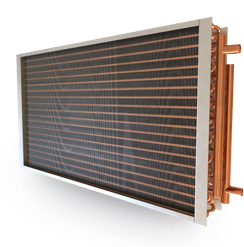
Condensing coils are essential components in any refrigerant-based HVAC system. As warm air moves across the fins and tubes of an evaporator/DX coil, liquid refrigerant absorbs heat and converts to vapor. The condenser coil then receives that superheated vapor, releases the heat to the surrounding environment, and converts the refrigerant back to liquid form. CRC engineers and builds custom and direct replacement condensing coils designed to your exact specifications, ensuring proper fit, performance, and long-term reliability.
Condensing Coil Process Configurations
CRC builds condenser coils for three distinct refrigeration process configurations. Each coil is engineered to meet the specific thermal and mechanical demands of its application:
Condenser
The condenser coil receives superheated refrigerant vapor from the compressor. It cools the vapor to its saturation point, fully condenses it to liquid, and continues cooling the liquid below saturation to a specified leaving temperature.
Desuperheater
A desuperheater coil receives superheated refrigerant vapor from the compressor and reduces its temperature to a controlled point that remains above the saturation temperature. Desuperheater coils are commonly used in heat recovery applications.
Subcooler
A subcooler coil receives liquid refrigerant from a condenser and further reduces its temperature below the saturation point to a specified leaving temperature. Subcooling improves system efficiency and helps prevent flash gas in refrigerant lines.
Direct OEM Replacement for Leading Manufacturers
CRC has mastered the engineering and fabrication of direct replacement condensing coils for the HVAC industry's most recognized OEM manufacturers, including Aerofin, American-Standard, Bohn, Carrier, Daikin, Lennox, Marlo, McQuay, Modine/Heatcraft, Nesbitt, Trane, Westinghouse, and York.
CRC maintains a library of 100+ years of OEM engineering drawings and proprietary heat transfer performance data. This archive allows CRC engineers to match the exact size, circuiting, and thermal performance of your existing coil, making installation straightforward with connections aligned to your facility's existing piping.
A dedicated CRC engineer is assigned to every project. That engineer will review specifications, visit your facility, take field measurements, or conduct a virtual consultation. CRC then generates detailed engineering drawings, performance evaluations, and formal quotations, while taking full responsibility for the accuracy and performance of your replacement condensing coil.
Condensing Coil Construction and Materials
Every CRC condensing coil is built using materials selected to match the thermal, pressure, and environmental demands of the application.
- Tube Materials: Copper, stainless steel, CuproNickel
- Fin Materials: Aluminum, copper, stainless steel
- Casing Materials: Galvanized steel, stainless steel
- Tube Enhancements: Internally rifled tubing available for improved heat transfer efficiency
- Circuit Options: Custom circuiting available to match specific capacity and pressure drop requirements
All CRC condenser coils are pressure tested before shipment to confirm leak-free performance and structural integrity.
Protective Coatings for Extended Condenser Coil Life
Condensing coils installed in corrosive or demanding environments require a protective coating to maintain performance and extend service life. CRC offers a full range of coating options for applications including:
- Automotive paint facilities
- Chlorinated pool environments
- Coastal and offshore locations
- Industrial manufacturing plants
- High UV exposure environments
- Medical and pharmaceutical facilities
- Restaurant kitchens
Available coil coating options:
- ElectroFin® E-Coat: The premier cathodic e-coating process, offering the highest-rated corrosion protection in the HVAC industry
- Endura® Coatings: 750+ engineered coating solutions across 11 technology platforms
- Infinigard: A two-part hybrid silicon-ceramic coating that bonds at the molecular level for outstanding oxidation and chemical corrosion resistance
- Phenolic: Excellent chemical resistance, durability, and UV protection
- UV Topcoat: Surface protection for high sun-exposure environments
Common Applications
CRC condensing coils are used across a wide range of commercial, industrial, and institutional facilities. Common applications include:
- Rooftop HVAC units and packaged systems
- Split system condensing units
- Chiller systems
- Data center cooling systems
- Cold storage and commercial refrigeration
- Industrial process cooling
- Healthcare and pharmaceutical facilities
- Educational campuses and government buildings
- Automotive manufacturing and paint facilities
For specialty or non-standard configurations, CRC engineers custom solutions to meet unique system layouts and coil geometry requirements.
Frequently Asked Questions
Yes. CRC maintains an extensive library of OEM engineering drawings and performance data for both current and discontinued manufacturers. Even if your original coil is no longer in production, CRC can engineer a direct replacement that matches the original fit and thermal performance.
CRC recommends a protective coating for any condenser coil operating in corrosive or demanding environments. This includes coastal locations, pool facilities, automotive paint facilities, industrial plants, high-UV environments, and medical or pharmaceutical settings. Protective coatings can be applied to new condensing coils to help extend service life and improve corrosion resistance.
Yes. CRC offers reliable shipping throughout the United States and Canada. Expedited shipping options are available upon request.
Why not give CRC a call now … and let’s work together to find the customized solution that is right for you!